Sion is one of League of Legends’ most underrated powerhouses. The undead colossus has seen multiple reworks over the years, but his current iteration stands as a tanky juggernaut that can flip entire teamfights with proper positioning and decision-making. Whether you’re playing top lane or support, understanding Sion’s kit, matchups, and playstyle separates a feeding tank from a unkillable fortress. This guide breaks down everything you need to climb with Sion in Season 2026, from early laning fundamentals to advanced macro plays that’ll have your team thanking you for the carries.
Table of Contents
ToggleKey Takeaways
- Sion is a scaling tank juggernaut that dominates teamfights with proper positioning and engage tools like his ultimate Unstoppable Onslaught.
- Maximize Sion’s passive by prioritizing CS over kills in early game—each minion grants 2 HP, creating exponential tankiness by mid and late game.
- Win bad matchups by farming safely and pivoting to teamfights where Sion’s utility and tankiness shine, rather than attempting risky 1v1s against duelists.
- Vision control and map awareness are Sion’s primary wincons; prevent ganks and overextension by warding river, tri-bush, and enemy jungle entrances.
- Master ability rotations in teamfights: initiate with R to split the enemy formation, follow with Q for knockup damage, and use W to absorb burst before cleaving with E.
- Sion climbs by understanding macro League of Legends fundamentals—objective prioritization, cooldown tracking, and team coordination—rather than mechanical outplays.
Who Is Sion And What Makes Him Unique
Sion’s Lore And Character Design
Sion wasn’t always a shambling corpse animated by dark magic, he was once Sion the Executioner, a brutal warrior enslaved and tortured by Noxus. After his death, dark magic resurrected him as an unstoppable force of nature, stripped of his humanity but given immense power. His lore ties into Noxus’s conquest of Ionia and the broader League universe, making him more than just another melee tank.
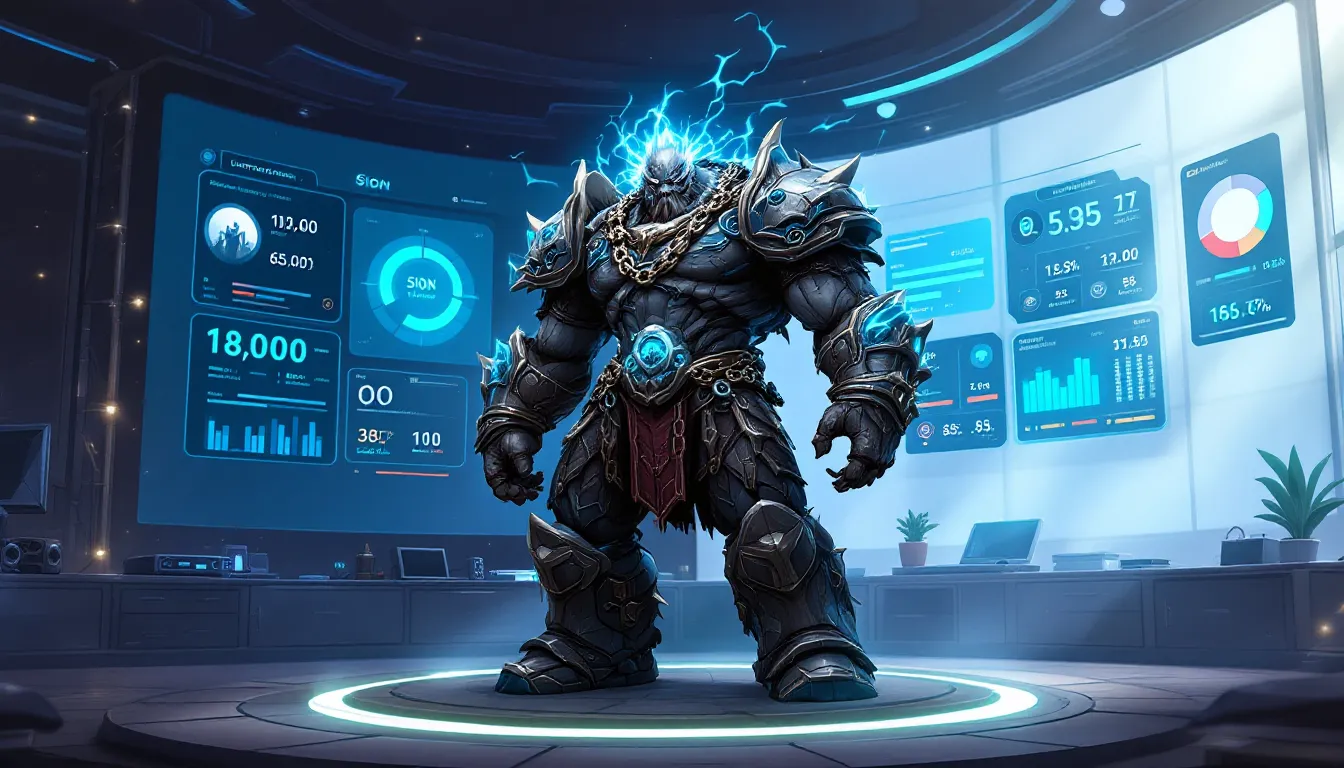
Design-wise, Sion embodies the juggernaut archetype: slow-moving, heavily armored, and harder to kill than most champions. His appearance, a massive, decaying colossus with chains and armor, matches his playstyle perfectly. He’s visually intimidating, which matters in solo queue because enemies respect the threat he poses.
Role And Position In The Game
Sion thrives as a top lane tank or a support in specific comps. In top lane, he scales exceptionally well into the mid and late game, gaining permanent HP whenever he kills minions or champions through his passive. This snowball potential makes him a bully in extended games where your team doesn’t ff at 15 minutes.
As a support, Sion works in select matchups where poke supports struggle. His engage and disengage tools, combined with his ultimate, make him a solid pick when your ADC can capitalise on the chaos he creates. Unlike other supports, Sion doesn’t scale on items as harshly, his utility and tankiness come from levels and raw stats, not gold efficiency. The League of Legends community has warmed up to Sion support in recent seasons, especially at higher elos where playmaking matters more than traditional role adherence.
Sion’s Abilities And Mechanics Explained
Passive: Glory In Death
Sion’s passive is what makes him unique. When he dies, he doesn’t stay dead immediately, instead, he becomes a massive, ghostly version of himself that can move toward the enemy fountain for a short duration. While in this state, he gains massive bonus AD and can still attack enemies, functioning as a delayed second life. This mechanic creates mind games: enemies must decide whether to recall or hunt down your revenant form.
Beyond the death mechanic, Sion’s passive grants him permanent HP whenever he kills minions or champions. Last-hitting minions grants 2 HP per unit, while champion takedowns grant 15 HP per kill. This passive encourages macro play and creates a win condition around farming safely while scaling.
Q: Decimating Smash
Decimating Smash is Sion’s primary engage and damage tool. He charges up and slams the ground, dealing damage to all enemies in a cone and knocking them up. The longer the charge, the further the knockup distance and the more damage dealt.
Usage is critical: hold Q to charge near enemies, forcing them to move or eat the knockup. Against grouped enemies, a charged Q can separate carry from peel, setting up kills for your team. Against split-push situations, use uncharged Q to farm and clear minions quickly. CDR matters heavily here, you want Q available frequently for both offense and waveclear.
W: Soul Furnace
Soul Furnace is Sion’s defensive and utility ability. He shields himself for a large amount, and after a 2-second delay, the shield detonates, dealing damage to nearby enemies. If the shield breaks or expires, Sion gains a smaller shield for the unused duration.
This ability defines Sion’s tankiness against burst. In teamfights, cast W proactively to absorb incoming damage and time the detonation to catch grouped enemies. Against skill shot-heavy champions (Lux, Xerath), shield preemptively to negate their all-in potential. The shield recharges every 8 seconds, so cycling shields during extended trades keeps you healthy without returning to base.
E: Roar Of The Slayer
Roar of the Slayer is a single-target ability that grants Sion bonus movement speed and cleaves through nearby enemies. The cleave applies full damage to the primary target and reduced damage to nearby enemies, making it excellent for waveclearing and trading in extended fights.
Use E to stick to enemies during chases, clear minion waves, and amplify damage when enemies clump. The movement speed allows Sion to chase targets or escape ganks, making it more flexible than it appears at first glance. Early game, max E second if you’re struggling with waveclear or kite potential.
R: Unstoppable Onslaught
Unstoppable Onslaught is Sion’s ultimate and his most valuable teamfight tool. He charges forward in a straight line, becoming immune to CC and steamrolling through enemies. Enemies hit are knocked aside, and Sion gains bonus movement speed for the duration. After the charge ends, he slams down, dealing damage to all nearby enemies.
This ability has no damage cap and scales with AD, making it deadly when ahead. Proper usage wins games: flank teamfights to split the enemy team, charge through walls to reach backline carries, or charge straight down lane to initiate when your team has vision control. The CC immunity makes it valuable against lockdown comps where you’d otherwise get shutdown. Pair R with Q for guaranteed knockups on isolated targets.
One key detail: Sion doesn’t gain damage per enemy hit, so focus on hitting as many champions as possible rather than aiming for wave damage.
Building Sion: Item Builds And Runes
Top Lane Tanky Build
The standard top lane Sion build prioritises tankiness with a touch of AD for the passive and ultimate scaling:
- Kaenic Rookern → Core first item into AP threats (Ahri, Kennen, Vlad). The magic resist and active shield make trades heavily in your favour.
- Sunfire Aegis → Mythic item providing waveclear, tankiness, and burn damage. Synergises with your passive for scaling HP.
- Thornmail → Into AD-heavy comps (Yasuo, Riven, Tryndamere). The armor and grievous wounds counter healing-dependent champions.
- Hollow Radiance → Late-game defensive item that amplifies tankiness further. Essential once enemies scale.
- Force of Nature → Into sustained magic damage or heavy AP comps. The movement speed helps with kite potential.
- Plated Steelcaps or Mercury’s Treads → Boots choice depends on enemy comp. Mercury’s if they have hard CC, Plated Steelcaps otherwise.
Optional items worth considering:
- Spirit Visage → Situational magic resist if your team has healing (Soraka, self-healing champs).
- Adaptive Helm → Against sustained magic damage from liabilities like Cassiopeia or Ryze.
Support Build Options
Support Sion follows a similar defensive pattern but prioritises utility items earlier:
- Hollow Radiance → Early tankiness for the aura effect. Provides engage threat without full tank items.
- Sunfire Aegis or Rylai’s Crystal Scepter → Sunfire for waveclear and damage, Rylai’s for engage utility and team fighting utility.
- Thornmail or Kaenic Rookern → Match enemy damage type.
- Plated Steelcaps or Mercury’s Treads → Same logic as top lane.
Support builds prioritise survivability and engage over raw tankiness. You’re not farming passively stacks like top lane Sion, so items that provide immediate utility matter more.
Rune Selections And Keystones
Grasp of the Undying is the primary keystone. The bonus damage per health chunk synergises with Sion’s tankiness, and the HP gain procs every few seconds during combat. This creates a self-healing loop that makes you harder to duel.
Alternative keystones:
- Aftershock → Into heavy engage comps where you need additional defense during fights. Underutilised but strong.
- First Strike → For scaling and early econ, though it sacrifices durability for damage.
Rune page breakdown:
-
Primary: Grasp of the Undying, Demolish, Second Wind, Overgrowth
-
Demolish lets you push towers efficiently when ahead.
-
Second Wind sustains early laning against poke.
-
Overgrowth adds scaling HP to pair with your passive.
-
Secondary: Conditioning + Unflinching OR Biscuit Delivery + Approach Velocity
-
Conditioning delays resistance itemization.
-
Unflinching helps against high-CC comps.
-
Biscuit Delivery provides early sustain if you’re struggling with mana or health.
-
Approach Velocity helps you stick to targets.
Priority stats to look for in itemization: Health, Armor, Magic Resist, CDR. Aim for 40% CDR by late game to maximize Q and W cooldowns.
Early Game Strategy And Laning Phase
Matchups And How To Win Lane
Sion’s early game is his weakest point. Without items or levels, he loses all-ins to champions with burst or sustained damage. Your gameplan changes dramatically based on your opponent.
Favourable matchups:
- vs Malphite, Maokai, Sejuani: These tank matchups turn into farm-fests. Neither of you kill the other, focus on CS and scaling. Push waves to deny enemy jungler gank angles.
- vs Jayce, Teemo, Kayle: Respect their early damage but don’t auto-pilot. Once you hit level 6, your ultimate outscales their poke. Hang near minion waves to bait their abilities into minions instead of you.
- vs Garen: Predictable all-in pattern. Space properly so his Q doesn’t silence you during your combos. Use Q to knock him away from all-in range.
Unfavourable matchups:
- vs Fiora, Jax, Trynd: These split-pushers duel you forever. Don’t fight them 1v1 unless you’re ahead. Group for teamfights where your team can collapse. Ban Fiora if she tilts you, she negates your tankiness with her W parry.
- vs Renekton, Darius, Mordekaiser: Early stat-checkers that beat you in raw dueling. Play safe, farm under tower, and wait for teamfights where your utility shines.
- vs Akali, Fizz, Ahri: AP assassins that kill you in rotations. Max resistances early, play passively, and set up vision for your jungler to gank them.
Laning win conditions:
- Survive without dying. Feeding kills matters more than CS at this stage.
- Match enemy roams when possible. A roaming opponent is vulnerable to ganks.
- Secure minion kills that grant passive HP. Even small stacks add up by mid-game.
- Ward river and tri-bush. Sion gets destroyed by ganks from immobile positions, so vision prevents snowballing.
Wave Management And Farming Tips
CS is Sion’s primary wincon. Every minion killed grants 2 HP via passive, and this stacking matters exponentially as the game progresses. Prioritise CS over kills in early game, a 5/0/0 Sion with low CS gets outdamaged by a 0/0/5 Sion with high CS by 15 minutes.
Wave management tactics:
- Freeze waves near your tower. If the enemy wave is pushing, don’t clear immediately. Let minions stack up, then clear with Q and AoE abilities. This denies enemy jungler gank opportunities and forces them to overextend.
- Crash waves into towers when enemy disappears. A roaming opponent can’t defend their tower. Use this window to claim CS and break tower plates.
- Manage lane pressure. Pushing automatically increases gank risk. After shoving a wave, back off and ward aggressively. Don’t autopilot farming into tunnel vision.
- Use E for waveclear efficiency. Late-game waveclear leans on E and Sunfire Aegis interactions. Practice animation canceling Q into E to clear faster and reduce downtime.
Farming under tower:
- Most minions require two tower shots + one auto or ability hit. Melee minions need two autos after tower hits. Ranged minions need one auto before tower hits, then another after.
- Use Q on caster minion waves to one-shot them at range.
- Practice CS under pressure. Enemy laners will poke you while farming, W shields counteract this.
Target 8 CS per minute early game (reasonable for your passive stacking) and scale to 7-9 CS per minute mid-late game. High-elo Sion players often hit 10+ CS per minute due to efficiency.
Mid And Late Game Gameplay
Team Fighting And Positioning
Sion’s mid-game is when he starts threatening teamfights. With items and levels, your tankiness skyrockets, and your engage potential dominates fights where enemies group.
Positioning principles:
- Initiate fights on your terms. Don’t wait for enemies to catch you out of position. Use R to flank or approach from an angle enemies don’t expect. Catching three grouped enemies with Q into R usually guarantees a won fight.
- Peel for carries when ahead. If your team drafted primarily damage dealers (ADC, mid laner), use W and E defensively to create space. Block skill shots with your body, you’re tanky enough to absorb them.
- Never stand behind your team. Sion’s engage range is his strength. Position at the frontline to threaten fights and make enemies respect your presence. Being in the backline reduces your impact to near-zero.
- Play around cooldowns. Your teamfight strength is tied to Q and R availability. Off-cooldown, farm or split. Once they’re up, look for plays.
Teamfight rotation:
- R in to disrupt enemy formation (aim for carries or CC-supports).
- Q immediately after landing to knockup grouped enemies.
- W proactively to absorb follow-up damage.
- E to cleave and stick to priority targets.
- Repeat abilities as cooldowns come up.
If teamfight breaks down or enemies kite successfully, pivot to waveclear and farming nearby minions for passive stacks.
Using Your Ultimate Effectively
Sion’s ultimate separates good Sion players from great ones. It’s not just an engage tool, it’s positioning tool, escape tool, and objective control tool rolled into one.
Engage usage:
- Charge through unwarded areas to surprise enemies. R through walls and terrain to reach backliners enemies think are safe.
- Time R when enemies are grouped (teamfights, objective contest). Hitting multiple champions guarantees impact.
- Charge slightly off-angle from carries. This splits enemy team and forces them to choose: peel for carries or focus you?
Escape usage:
- Use R to create distance when your team is retreating. The CC immunity negates CC chains, and momentum carries you away from danger.
- Charge through teammates toward fountain when desperate. Enemies respecting the knock-away effect often give up chases.
Objective control:
- Use R to initiate Baron or Dragon fights when your team has numbers advantage. The guaranteed engage often translates to objective control.
- Charge past wards into teamfights around objectives. Enemies warding Baron don’t expect aggressive R engages.
Pro tip: Don’t charge through enemy fountain when it’s irrelevant to the game state. Late-game, momentum matters less than teamfight presence. Position in lane instead of inting with fountain charges.
Ultimate cooldown sits around 90 seconds at rank 1 and 60 seconds at rank 3. Play around this timer, off-cooldown, respect enemy engage: once it’s available, look for plays.
Common Mistakes And How To Avoid Them
Overextending Without Vision
Sion dies when caught out due to his immobile nature. Unlike champions with escapes (Ahri, Kassadin, Zed), Sion can’t kite or reposition once enemies close distance. A single dark area on the map is enough for enemies to set up a pick.
Mistake: Pushing lane too far without river ward. Enemy jungler shows up, you get caught, enemy team snowballs kill streak.
Solution: Always maintain vision control. Deep wards in river tri-bush and enemy jungle tell you where enemies are. If you can’t see enemies, don’t push. Back off to tower and farm safely.
Mistake: Farming bot lane alone at 20 minutes while enemies could be grouping. You get caught, and now your team fights 4v5.
Solution: Wave management matters. If enemies are missing, farm under tower or near your team. The passive HP stacks don’t mean anything if you’re dead.
Mistake: Standing in one spot (farming near a ward or itemizing at tower) for too long. Enemy stacks up on map and catches you during animation.
Solution: Always have an escape plan. Position near minion waves so you can farm while mobile. If enemies rotate, instantly back off.
Think: Would I die if a champion appeared from that direction? If yes, move.
Ability Rotation Errors
Sion’s abilities have interactions that create optimal rotations. Wasting them or using them inefficiently tanks your damage output and tankiness.
Mistake: Using Q as a finisher on low-health minions. Q’s long cooldown means you waste it farming when you should save it for enemy engages.
Solution: Use E for single-target minion kills. Reserve Q for enemy champions or grouped minion waves that need clear.
Mistake: Casting W reactively to burst damage without understanding when it will detonate. You take the hit, shield pops, and you’re back to being squishy.
Solution: Shield preemptively before trades. Against predictable burst (Darius E-Q, Garen silence into auto), pop W before they commit. The shield duration means it often blocks the full burst.
Mistake: Charging R straight into tower or enemies without a plan. You deal damage, get CC’d immediately after, and die in retaliation.
Solution: Angle R toward enemy positioning, not raw damage. Aim to separate carries from peel or force bad positioning. If you’re going to die after charging, it’s not worth the engage.
Mistake: Using all cooldowns on one target instead of spreading damage and CC for teamfight advantage.
Solution: In teamfights, Q the grouped enemies (knocks up multiple targets), W for zone control, and E to cleave through multiple champions. Don’t tunnel one carry, the AoE damage spreads across all enemies.
Practice combos in Practice Tool against dummies. Q into R, W into E, R into Q, understand cooldown interactions so they become automatic in-game.
Sion Matchups: What To Expect Against Popular Champions
Sion’s matchup spread varies wildly. Some lanes are unplayable, while others favor him heavily. Understanding the nuances prevents autopiloting into bad trades.
Tier S (Sion favours):
- vs Malphite: Infinite stalemate. Neither of you kill the other. Farm and win via superior teamfight with R engage.
- vs Maokai: Another tank. Push waves, scale, and outteamfight with R utility.
- vs Ornn: Ornn struggles early. Space his Q-E combo and punish with Q knockup. Once he scales, teamfights become his turf, group accordingly.
Tier A (Sion slightly favours):
- vs Kayle: Abuse her early weakness. Once she hits level 11, respect her damage and group for teamfights.
- vs Kennen: Play around his electric burst. Use W to absorb E-R. Once R is down, all-in becomes viable.
- vs Aatrox: His long cooldowns mean you can trade safely between his rotations. Respect his engage range and poke accordingly.
Tier B (Skill matchups):
- vs Jayce: Respect his poke, but he has weak all-in. If he all-ins, W then fight back. Once you hit 6, R engage over-statchecks his damage.
- vs Gangplank: His barrels are annoying, but Sion tanks them. Space his E-combo, and once he’s out of mana, he’s useless.
- vs Volibear: Early game goes his way. Post-6, R engage over-statchecks him, but he still doles out insane damage. Play for teamfights.
Tier C (Sion slightly disfavours):
- vs Quinn: She kites you forever and heals off passive. Safe farming under tower and grouping for teamfights is mandatory. Never chase her alone.
- vs Teemo: Annoying but not unwinnable. Gank pressure and R engage make up for early poke disadvantage.
- vs Warwick: Post-6, he outduels you immensely. Farm safely and avoid 1v1s. He falls off late if you survive early.
Tier D (Sion disfavours):
- vs Fiora: She negates your tankiness with W parry. Ban or dodge. If forced to play it, play ultra-safe and group for teamfights only.
- vs Jax: He stat-checks you early and scales harder. Play safe, farm under tower, and pray your team carries.
- vs Mordekaiser: His all-in burst is massive. Respect his range, space his E, and don’t get caught in extended trades.
- vs Renekton: Early stat-check that’s hard to overcome. Play passively and farm. Once you scale, you outteamfight him, but surviving laning phase is the challenge.
- vs Darius: His heal and execute negate your tankiness. Respect his range, space his E, and don’t get caught in extended trades.
Tier F (Auto-lose):
- vs Akali: She kills you in 2 seconds. Play ultra-passively or dodge. Teamfights are rough unless you catch her flanking.
The key to winning bad matchups is accepting the lane goes even or slightly negative, then outscaling via teamfighting. Sion shines in 5v5, so pivot to macro play rather than hoping to 1v1 a duel champ.
Advanced Tips To Climb With Sion
Climbing with Sion requires macro understanding beyond mechanics. High-elo Sion players leverage map control, objective prioritization, and team synergy to win games.
Vision is primary wincon. Control river and jungle entrances. A warded map prevents ganks and enables aggressive laning. Conversely, uncontested vision often leads to picked-off teammates and snowballing enemy teams. Invest in control wards constantly, the investment pays for itself after one prevented death.
Manage kill gold distribution. If you’re ahead, let carries finish kills. Your value comes from tankiness and engage, not raw damage. A 3/0 mid laner with kill gold wins faster than a 3/0 Sion with all kill gold. This sounds counterintuitive but matters immensely for game tempo.
Play split-push only when ahead. Sion isn’t an amazing 1v1 champ, but a fed Sion with Sunfire Aegis and R available can pressure split-lanes hard. If behind, group and teamfight. Split-push is a last resort, not a primary strategy.
Track ultimate cooldowns. Know when your R is available and when enemies’ ultimates are down. A 10-second R advantage means you can take a forced teamfight that enemies can’t answer. Conversely, walking into teamfight while your R is down is griefing.
Coordinate with junglers. Sion’s engage is reliable. If your jungler knows you’re looking to R in, they can collapse with ganks or counterengage. Quick communication (ping, chat) makes the difference between a wasted ultimate and a snowballing teamfight.
Stop tilting over early game disadvantages. Sion loses early but wins late. If you’re 0/2 by 10 minutes, it’s not inting if you farm safely and scale. Many Sion climbers mentally reset early deficits and focus on macro win conditions. This mentality wins games that feel lost at 15 minutes.
Learn win conditions. Some games require you to farm and scale. Others require early aggression to snowball. Read the game: Are your laners ahead? If yes, invade enemy jungle and secure kills. Are they behind? If yes, farm and group for teamfights. Flexibility beats rigid playstyles.
Watch competitive Sion gameplay. Pro players showcase macro patterns and optimal itemization. Understanding how professionals leverage Sion’s strengths teaches you patterns to replicate in solo queue.
Abuse passive stacking in extended games. If games go 40+ minutes, your passive HP stacking creates exponential tankiness advantages. Enemies with fixed health pools fall off relative to your scaling. Play for late-game teamfights and let game timer work in your favor.
Understand team composition synergies. Sion works best with teams that have reliable damage (ADC, mid laner) since his engage creates opportunities. Sion with four CC-heavy tanks often struggles since you need damage to convert engages into kills. Pick accordingly or request team composition adjustments.
Conclusion
Mastering Sion requires patience and macro understanding over mechanical flashiness. He’s not a mechanical outplay champion, he’s a scaling, engagement-focused tank that thrives when teams coordinate around his strengths.
Start by learning matchups and laning fundamentals. Farm safely, respect enemy engage patterns, and avoid overextending without vision. Once you hit mid-game with items, pivot to teamfighting where Sion shines. Use R to initiate, Q to knockup grouped enemies, and W to absorb burst damage. Keep scaling via passive HP stacks and let your tankiness compounds as the game extends.
Climbing with Sion separates players who understand macro League of Legends from those who chase kills and ignore map control. Play for objectives, manage cooldowns, and coordinate with teammates. The undead colossus may not be flashy, but a well-piloted Sion often feels completely unstoppable by late-game, turning teamfights into guaranteed wins.
If you’re looking for deeper champion dives and meta analysis, platforms like Mobalytics offer tier lists and matchup data updated regularly. For competitive context, esports coverage shows how professional players leverage Sion in high-stakes games. Finally, exploring the League of Legends cinematic universe adds context to Sion’s story and reminds you why this undead warrior deserves respect in Summoner’s Rift.
Start your climb, secure your passive stacks, and may your teamfights be as hard to lose as a full-built Sion tank.