The League of Legends world map, officially known as Runeterra, has evolved from a simple competitive backdrop into one of gaming’s most intricate fictional universes. What started as a basic arena for clashing champions has transformed into a sprawling, lore-rich continent spanning multiple regions, each with distinct cultures, politics, and champions. If you’ve ever wondered why Garen fights for Demacia or what makes Ahri inherently tied to Ionia, you’re looking at the world map in action. Understanding Runeterra isn’t just for lore enthusiasts: it shapes champion design, regional theming, and even competitive narratives that define the esports landscape. This 2026 guide breaks down everything you need to know about the League of Legends world map, from its history and major regions to how it influences gameplay and lore storytelling.
Table of Contents
ToggleKey Takeaways
- The League of Legends world map, Runeterra, has evolved from a simple competitive backdrop into a complex fictional universe with eight distinct regions, each with unique cultures, politics, and champion archetypes.
- Understanding the League of Legends world map enhances gameplay appreciation by revealing how regional identity directly shapes champion abilities, playstyles, and thematic synergies across the game.
- Each Runeterra region reflects specific philosophies: Noxus values militaristic strength, Demacia emphasizes justice, Piltover pursues scientific progress, while Ionia, Bilgewater, Freljord, Shurima, and Shadow Isles each explore distinct magical and cultural traditions.
- Champions’ interconnected stories across Runeterra create meaningful narrative weight; regional conflicts like Noxus versus Demacia and Piltover-Zaun class division add layers to competitive matchups beyond mechanical skill.
- Runeterra extends far beyond the game through transmedia storytelling, including Netflix’s Arcane, the Legends of Runeterra card game, novels, and cinematics, making it one of modern gaming’s most developed fictional universes.
- Regional themes directly influence competitive League of Legends, with esports teams leveraging regional identity narratives, champion pools reflecting cultural playstyles, and Worlds tournaments using Runeterra lore to create thematically significant matchups.
What Is The League Of Legends World Map?
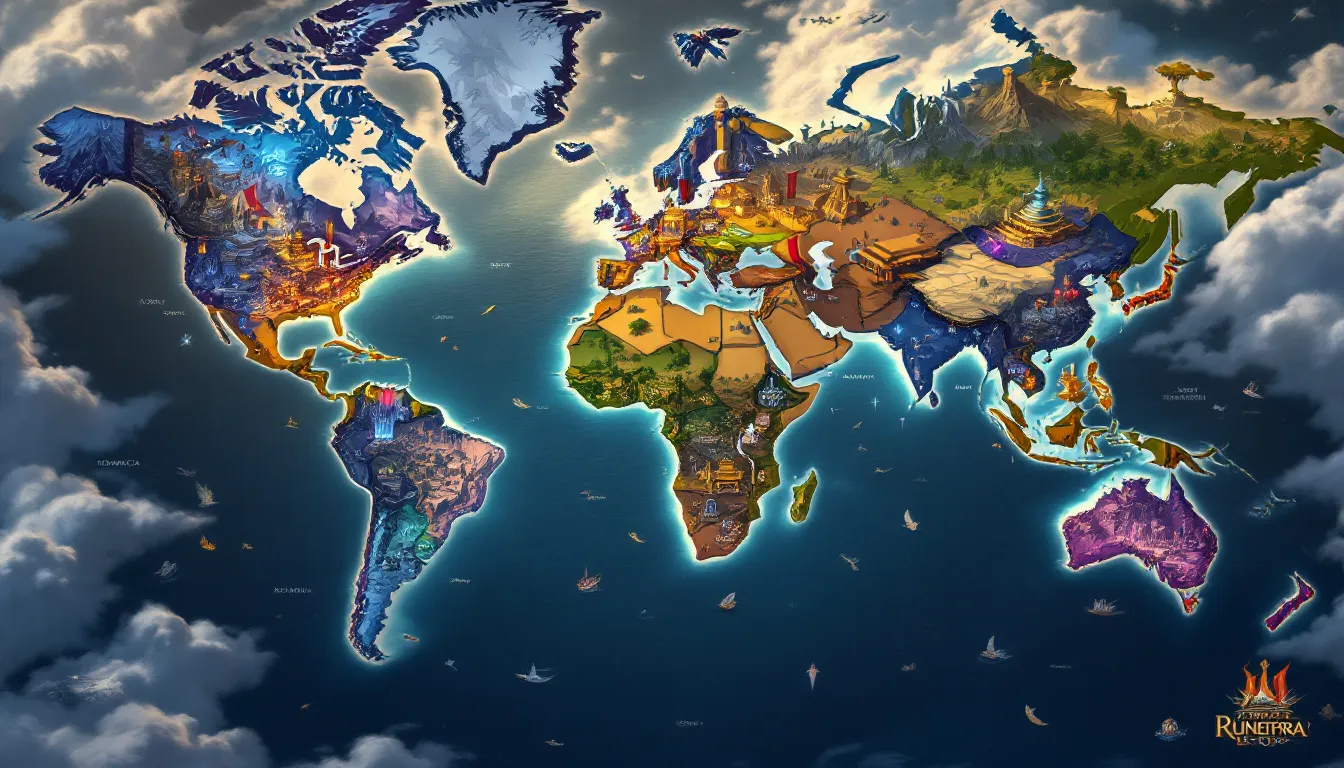
The League of Legends world map is Runeterra, a fantasy continent where all champions originate and where the game’s narrative unfolds. It’s not just aesthetic window dressing, Runeterra is the backbone of champion lore, regional identity, and thematic consistency across the entire franchise.
Runeterra is divided into distinct regions, each representing different political systems, magical traditions, and cultural values. Noxus champions are militaristic and aggressive. Demacia champions embody justice and honor. Piltover represents scientific progress, while Zaun embraces darker, more experimental magic. This thematic separation extends to ability design, champion archetypes, and even how regions interact within the lore.
What makes the world map particularly important is that it’s not static. Riot Games has continuously expanded Runeterra through cinematics, novels, card games like Legends of Runeterra, and the Netflix series Arcane. The map has evolved from a gameplay necessity into a full transmedia universe where the world of League extends far beyond the Rift.
Players don’t need to memorize every detail to enjoy competitive League, but understanding regional connections enhances appreciation for why certain champions synergize thematically, how champion releases fit into broader narrative arcs, and why Riot prioritizes certain regions for storytelling in specific years.
The History And Evolution Of Runeterra
Runeterra was introduced at League’s 2009 launch as a simple medieval fantasy setting. Early lore was minimal, basically enough justification for why champions fought on the Rift. Demacia and Noxus existed as opposing factions, Piltover had some vague industrial aesthetic, and everything else was filler.
The real transformation began around 2014–2016, when Riot started taking Runeterra seriously. Champion reworks came with full narrative overhauls. Sion went from a mindless zombie to a fallen Noxian general. Gangplank shifted from a random pirate to Bilgewater’s crime lord with political implications. The lore started interconnecting, champions weren’t just individuals, they were pieces of a larger world.
The turning point came with the 2019 League of Legends: Realms of Runeterra universe expansion. Riot officially released detailed region guides, timeline information, and began publishing novels. Arcane (2021) cemented this approach, showing that Runeterra could sustain complex storytelling across multiple mediums. Suddenly, casual players wanted to understand the world their champions came from.
By 2024–2026, Runeterra is one of gaming’s most developed fictional universes, with tie-ins across Netflix series, trading card games, mobile games (Legends of Runeterra, Teamfight Tactics), and continuous lore updates via cinematics and “Color Story” articles on the official League website.
Regional Development Over The Years
Each region’s development reflects Riot’s broader vision for the world. Noxus and Demacia have been core since launch but were fleshed out around 2015–2017 with champions like Swain, Katarina, and Jarvan IV receiving deep lore overhauls that explored regional politics.
Ionia remained a vague “spiritual place” until champion releases like Senna and the Yone rework (2020) grounded it in tangible cultural identity. Similarly, Bilgewater was nothing until Gangplank’s 2015 rework gave it actual world-building with pirates, commerce, and moral complexity.
Shurima and Shadow Isles were largely dormant lore-wise until 2018–2020, when Riot invested heavily in their narratives. Ascension became a central magical concept, and Shadow Isles gained layers through champions like Gwen and the Sion rework.
Freljord is interesting because it went from generic “ice place” to a region of supernatural significance. The Ornn and Volibear reworks (2019–2020) revealed that Freljord is home to actual gods, reshaping how the entire magic system works.
This progression shows Riot’s evolution: early regions (Noxus, Demacia, Piltover) were combat-focused, while later regions explore metaphysics, spirituality, and environmental storytelling.
Major Regions Of Runeterra Explained
Understanding each region is essential for appreciating champion design and lore connections. Here’s what defines Runeterra’s eight major regions:
Noxus: The Militaristic Empire
Noxus is Runeterra’s military superpower, an imperialist regime built on conquest, strength, and martial excellence. The region values power above all else: weakness is viewed as failure. Notable champions include Darius, Swain, Katarina, Draven, and Samira.
What makes Noxus fascinating is its moral ambiguity. It’s not purely “evil”, Noxian culture genuinely believes in meritocracy and strength through struggle. Swain as a character embodies this: he’s ruthless and pragmatic, but also genuinely cares about Noxian stability. This complexity makes Noxian champions engaging to play and understand.
Noxian military strategy dominates lore conflicts, and the region is locked in eternal tension with Demacia, making their matchups narratively significant.
Demacia: The Golden Kingdom
Demacia is the counter to Noxus, a kingdom built on law, justice, and honor. Demacian champions are typically noble, righteous, and committed to protecting innocents. Champions include Garen, Lux, Jarvan IV, Sylas, and Poppy.
Demacia’s defining characteristic is its xenophobia toward magic. This creates internal conflict, Lux is secretly magical, Sylas is a magic-wielding rebel, and the kingdom’s absolutist stance creates moral gray areas. The region isn’t naively good: it’s good people with problematic systems.
Demacian aesthetics are European medieval: heavy armor, castles, banners, and formal military structure. Gameplay-wise, Demacian champions often feature durability and protection mechanics.
Piltover And Zaun: Progress And Shadow
Piltover is a trading city-state obsessed with progress, invention, and scientific advancement. Zaun is Piltover’s shadow, the undercity where progress happens without ethics, where chemtech and dark innovation thrive. Champions span both: Jayce and Caitlyn (Piltover), Jinx and Warwick (Zaun).
Arcane made this dynamic incredibly clear. Piltover benefits from Zaun’s innovation (hextech) while ignoring Zaun’s suffering. The socioeconomic divide between these regions is the most tangible in Runeterra’s lore.
Gameplay-wise, Piltover champions emphasize control and transformation (hexgates, portals), while Zaun champions favor explosive, unpredictable abilities reflecting the region’s chaotic nature.
Ionia: The Spiritual Homeland
Ionia is Runeterra’s spiritual center, inspired by East Asian cultures. The region is fundamentally magical, built on balance between nature, spirits, and humans. Champions include Ahri, Shen, Akali, Yasuo, and Yone.
Ionia’s core theme is harmony disrupted. The region was invaded by Noxus, creating lasting trauma. Champions like Akali represent rebellious responses, while Shen embodies spiritual duty. Yasuo is a wanderer seeking redemption, and Yone bridges the mortal and spiritual worlds.
Ionian aesthetics are inspired by Japanese, Korean, and Chinese art: pagodas, bamboo forests, flowing silks, and spiritual symbolism. Mechanically, Ionian champions often have movement, evasion, and skill-shot dependent abilities reflecting graceful, flowing combat.
Bilgewater: The Pirate’s Haven
Bilgewater is a pirate republic on the high seas where might makes right, alliances shift constantly, and treasure drives ambition. Gangplank, Miss Fortune, Twisted Fate, and Illaoi call Bilgewater home.
Bilgewater is refreshingly amoral. Champions here aren’t fighting for justice or honor: they’re chasing power, revenge, or survival. Gangplank and Miss Fortune are locked in a vendetta. Illaoi is a priestess of a sea god with her own agenda. This moral flexibility makes Bilgewater narratives unpredictable and entertaining.
The region’s aesthetic is swashbuckling pirate: ships, docks, tropical islands, and weathered seafarers. Mechanically, Bilgewater champions emphasize aggression, risk-reward gameplay, and direct confrontation.
Freljord: The Frozen Wasteland
Freljord is Runeterra’s harshest region, an eternal winter where survival is paramount. The region’s magic is tied to the land itself through demigods and aspects. Champions include Ashe, Sejuani, Lissandra, Volibear, and Ornn.
Freljord’s lore is uniquely complex because the region isn’t unified. Ashe leads the Avarosan tribe toward prosperity and peace. Sejuani rules the Winter’s Claw with brutal strength. Lissandra is an ancient being manipulating the region toward her own goals. These factions are in constant conflict, and newer lore reveals that Freljord is home to actual gods (Volibear, Ornn) operating at scales beyond mortal politics.
The region’s aesthetic is Norse/Arctic: ice, stone, tribal aesthetics, and emphasis on endurance. Mechanically, Freljord champions often have crowd control and defensive tools reflecting the harsh environment.
Shurima: The Desert Empire
Shurima is an ancient, fallen empire being reclaimed by its people. Once a magical superpower, it collapsed into desert and ruin. Champions like Azir, Xerath, Taliyah, and Nasus represent different facets of Shuriman identity.
Azir seeks to restore Shurima through leadership and honor. Xerath represents magical ambition without restraint. Nasus is an ancient god-warrior trapped in decline. Taliyah is a young mage learning her place in a world claiming its past.
Shurima’s magic is fundamentally tied to Ascension, a process transforming mortals into god-like beings. This concept is central to the region’s lore and explains why Shuriman champions often have imperial, magical themes.
The aesthetic is Egyptian and Arabian-inspired: pyramids, desert architecture, gold, and ancient mysticism. Mechanically, Shuriman champions emphasize area control and magical power scaling with late-game carries.
Shadow Isles: The Cursed Lands
Shadow Isles is Runeterra’s dark heart, an archipelago cursed by dark magic where death doesn’t bring peace. Champions here are typically undead, corrupted, or spiritually tortured: Thresh, Hecarim, Kalista, Maokai, and Gwen.
The Shadow Isles represent Runeterra’s most tragic stories. Kalista was betrayed and cursed into undeath. Thresh is a sadistic jailer trapping souls. Hecarim is a general cursed to eternal war. Maokai is nature corrupted and twisted. Even newer champions like Gwen are grappling with curse and corrupted magic.
The aesthetic is dark gothic: ruins, spectral imagery, twisted nature, and overwhelming despair. Mechanically, Shadow Isles champions often have death-related mechanics, crowd control, and sustainability through dark magic.
Interconnected Lore And Character Backstories
One of Runeterra’s greatest strengths is how interconnected the lore has become. Champions aren’t isolated: their stories intersect, conflict, and resolve across regions. This interconnectedness deepens when you understand the world map.
Noxus and Demacia have been at war for centuries. Garen and Katarina are ideological enemies from opposing sides, this rivalry has real narrative weight because it’s not just about individuals, it’s about regional philosophy. Similarly, Swain’s ascension to Noxian leadership directly impacts how other champions perceive the empire.
Arcane brilliantly illustrated Piltover-Zaun connections. Powder becomes Jinx, creating a bridge between regions that defines both her character and broader world politics. The hextech invention that empowers Piltover literally comes from Zaun innovation, showing how regions are economically and narratively intertwined.
Ionia’s invasion by Noxus created ripple effects across the region. Yone became a spirit after the invasion. Akali’s rebellion is a direct response to Noxian occupation. Shen’s duty to balance comes from Ionian spiritual traditions endangered by external conflict. A single historical event reshapes multiple champions’ stories.
Freljord champions are locked in tribal conflict, but the revelation that demigods like Ornn and Volibear exist changes everything. Ashe doesn’t just lead a tribe: she might be destined to unite a region while literal gods position themselves. Lissandra’s ancient manipulation connects Freljord to events from thousands of years ago, suggesting the region’s conflicts are part of much larger cosmic struggles.
Shurima and Shadow Isles share magical concepts. Both regions deal with immortality, Ascension in Shurima versus curse in Shadow Isles. Kalista was originally bound by a Shuriman curse before being corrupted by Shadow magic. These connections show how magic systems interlink across Runeterra.
Understanding these connections enriches gameplay. When you play Azir versus Kalista, you’re not just watching ability animations, you’re watching a region trying to reclaim glory versus undeath’s corruption. These narratives reward lore knowledge and make the world feel alive.
How Regional Identity Shapes Gameplay
Runeterra isn’t just lore flavor, regional identity directly influences game design, champion balance, and how champions function within their roles.
Champion Origins And Regional Themes
Every champion’s abilities reflect their regional identity. Demacian champions like Garen and Jarvan IV have defensive, crowd-control heavy kits emphasizing protection and sustained combat. Noxian champions like Darius and Katarina have aggressive, execution-focused abilities reflecting martial superiority.
Ionian champions emphasize movement and graceful evasion. Yasuo and Akali are skill-dependent with high mobility, reflecting Ionia’s spiritual combat traditions. Freljord champions like Ashe have crowd control and area denial, reflecting the harsh, unforgiving terrain.
Piltover champions are about transformation and control. Jayce literally transforms between forms. Heimerdinger builds and controls structures. Caitlyn uses traps and vision control. These mechanics reflect Piltover’s technological philosophy. Zaun champions like Jinx and Warwick are chaotic and explosive, sometimes with unreliable but high-damage kits reflecting Zaun’s experimental, anarchic nature.
This thematic consistency means regional identity and gameplay feel cohesive. When you play a champion, their mechanics reinforce their cultural identity. League of Legends Cinematics feature these champions in action, showcasing their regional aesthetics and thematic abilities in stunning detail.
Map Design And Game Balance
The Rift itself reflects Runeterra’s balance between order and chaos. It’s symmetrical (representing fair competition) but also drawn from a mystical place where champions are summoned to battle. The map design, with river control, jungle positioning, and objective placement, creates gameplay that feels thematic even if players never think about it.
Regional representation in champion rosters also affects meta diversity. When Riot releases a new Noxian champion, it potentially shifts top-lane or mid-lane meta because that region values martial strength. New Ionian releases might change jungle pathing because Ionian champions emphasize evasion and mobility.
Balance patches often consider regional identity. A Demacian support champion might need different tweaks than a Bilgewater one because their regional philosophies demand different power profiles. Demacian supports protect allies (defensive), while Bilgewater supports might embrace chaos and unpredictability.
Exploring The World Map In Hextech Gates And Special Events
Beyond base League of Legends, Runeterra is explored through special events, limited-time modes, and alternate game types.
Hextech Gates is a feature allowing players to explore Runeterra’s regions through special missions and storytelling. Different regions unlock different champions, cosmetics, and lore snippets. This isn’t just aesthetic, it’s Riot’s way of deepening player connection to the world.
Project Overdrive and other battle pass events often feature regional themes, giving players cosmetics tied to specific regions. Arcane inspired Piltover and Zaun cosmetics that made region-specific champion skins available, letting players express their connection to specific regions.
Legends of Runeterra, the collectible card game, is structured entirely around regions. Building decks means choosing regional identities and synergies. This card game has become a major vehicle for exploring Runeterra lore, releasing new information about regions and champions simultaneously with card mechanics.
Teamfight Tactics (TFT) similarly uses regional synergies as core mechanics. Some seasons emphasize Noxus synergies, others focus on Ionian or Piltover. This makes TFT a dynamic way to explore how regions interact through game balance.
These explorations ensure that Runeterra isn’t static. Players constantly encounter new region-specific content, keeping the world feeling expansive and evolving. Special events like the Sentinels of Light arc (2021) explored Shadow Isles lore while letting players experience the region through gameplay narratives.
Impact On Esports And Competitive Lore
Runeterra’s world map has massive implications for esports storytelling, team branding, and narrative engagement.
Teams have started embracing regional themes. LoL World Championship teams from different regions sometimes adopt champion pools that reflect their regional identity or cultural connection. Teams from Korea often excel with Ionian champions, reflecting the spiritual, methodical playstyle associated with the region. European teams might favor Noxian champions emphasizing raw mechanical skill.
Narrative arcs in esports leverage Runeterra lore. When Fnatic (EU) faces T1 (Korea), there’s potential for a thematic Demacia versus Ionia conflict, adding narrative layers beyond pure competition. Riot has increasingly crafted tournament narratives using regional conflict, Worlds 2022, for example, featured regional themes in its opening ceremony and visual design.
Cinematic storytelling around Worlds tournaments often explores Runeterra conflicts. The 2022 Worlds cinematic featured Azir and other champions in a narrative reflecting competitive regions colliding. This integrates the world map directly into esports presentation, making Runeterra part of the competitive experience rather than just a backdrop.
Competitive patch cycles sometimes emphasize specific regions’ champions. When Riot nerfs Noxian champions across the board, it shifts the regional meta and forces teams to adapt. Teams must now pioneer Demacian or Ionian compositions, creating fresh competitive narratives.
Professional analysis platforms like Mobalytics now include regional context when discussing champion meta, helping competitive viewers understand why certain champion pools represent specific playstyles or regional identities. Similarly, Game8 tier lists often organize champions by region, recognizing that regional identity matters for both casual understanding and competitive strategy.
LoL Esports has increasingly marketed regional conflict narratives, using Runeterra lore to make competitive matchups feel thematically significant. When powerhouse regions clash, it’s not just mechanical skill, it’s philosophical and cultural conflict made tangible through League champions.
Conclusion
The League of Legends world map is far more than background lore, it’s the foundational architecture of champion design, narrative depth, and competitive storytelling. Understanding Runeterra transforms how you experience League, whether you’re playing casually, pushing ranked, or watching professional esports.
Each region tells a complete story: Noxus’s militaristic ambition, Demacia’s righteous struggle, Piltover and Zaun’s class conflict, Ionia’s spiritual balance, Bilgewater’s moral ambiguity, Freljord’s divine presence, Shurima’s magical legacy, and Shadow Isles’ tragic corruption. These aren’t just flavor, they’re design frameworks that make every champion feel authentic and interconnected.
As Riot continues expanding Runeterra through Netflix series, novels, card games, and new champion releases, the world map grows richer. The 2026 Runeterra is exponentially deeper than 2009’s initial setting. For new players, this depth offers incredible storytelling to discover. For veterans, it means every new region explored and every champion released carries narrative weight.
Whether you main a Demacian duelist, an Ionian monk, or a Bilgewater rogue, you’re part of Runeterra. Understanding the world map enriches that connection, making League of Legends not just a game but a gateway to one of modern gaming’s most ambitious fictional universes.