League of Legends esports has evolved from niche streaming content into a global phenomenon rivaling traditional sports in viewership and production value. By 2026, three regional powerhouses dominate the competitive landscape: the European League Championship (LEC), the League Championship Series (LCS), and the Korean League Championship (LCK). Each region brings its own playstyle, competitive culture, and championship pedigree to the table. If you’re trying to understand where the best League of Legends competition happens, which teams to follow, or how these leagues connect on the international stage, this breakdown covers everything you need to know.
Table of Contents
ToggleKey Takeaways
- League of Legends esports is dominated by three regional powerhouses—the LEC, LCS, and LCK—each with distinct playstyles, competitive cultures, and championship records.
- The LCK stands as the most dominant regional league, producing mechanically skilled players through intense training culture and the world’s most competitive solo queue environment.
- The LEC emphasizes macro play and strategic adaptability, winning through superior objective control and creative drafting rather than raw mechanical outplays.
- The LCS faces competitive challenges with inconsistent mechanical skill and reactive meta adaptation, often trailing behind the LEC and LCK in international performance.
- League of Legends World Championship and Mid-Season Invitational (MSI) serve as the prestige international events where regional champions prove their worth on the global stage.
- New fans should start by watching playoff matches, pick a team that resonates with them, and engage with esports communities to deepen their understanding of competitive League of Legends.
What Are League of Legends Professional Leagues?
League of Legends professional leagues are the top-tier competitive environments where teams battle for regional supremacy and qualification to international tournaments. These aren’t casual competitions, they’re fully structured franchises with salary caps, academy systems, and development pipelines that feed talent into the main league.
Each region operates independently under Riot Games’ oversight but follows a unified competitive ruleset. Teams compete in best-of-three or best-of-five series depending on the league format, earning Circuit Points that qualify them for international events like Worlds and the Mid-Season Invitational (MSI). The stakes are massive: championship wins come with prize pools, franchise revenue, sponsorship deals, and most importantly, the right to represent their region on the world stage.
These leagues also serve as talent factories. Scouts from all three regions constantly hunt for rising stars in lower divisions and academy teams. A diamond-ranked solo queue grind or a dominant academy season can launch a player’s career into the professional spotlight. The difference between a regional league and international success often comes down to how effectively each region develops its players and adapts its competitive meta.
The European League Championship (LEC)
League Format and Competition Structure
The LEC operates on a franchise model with twelve teams competing in a traditional regular season followed by playoffs. As of 2026, the league runs both spring and summer splits, each awarding Circuit Points that accumulate toward Worlds qualification. The split structure lets teams test new rosters and strategies twice a year, creating opportunities for mid-season adjustments and talent showcases.
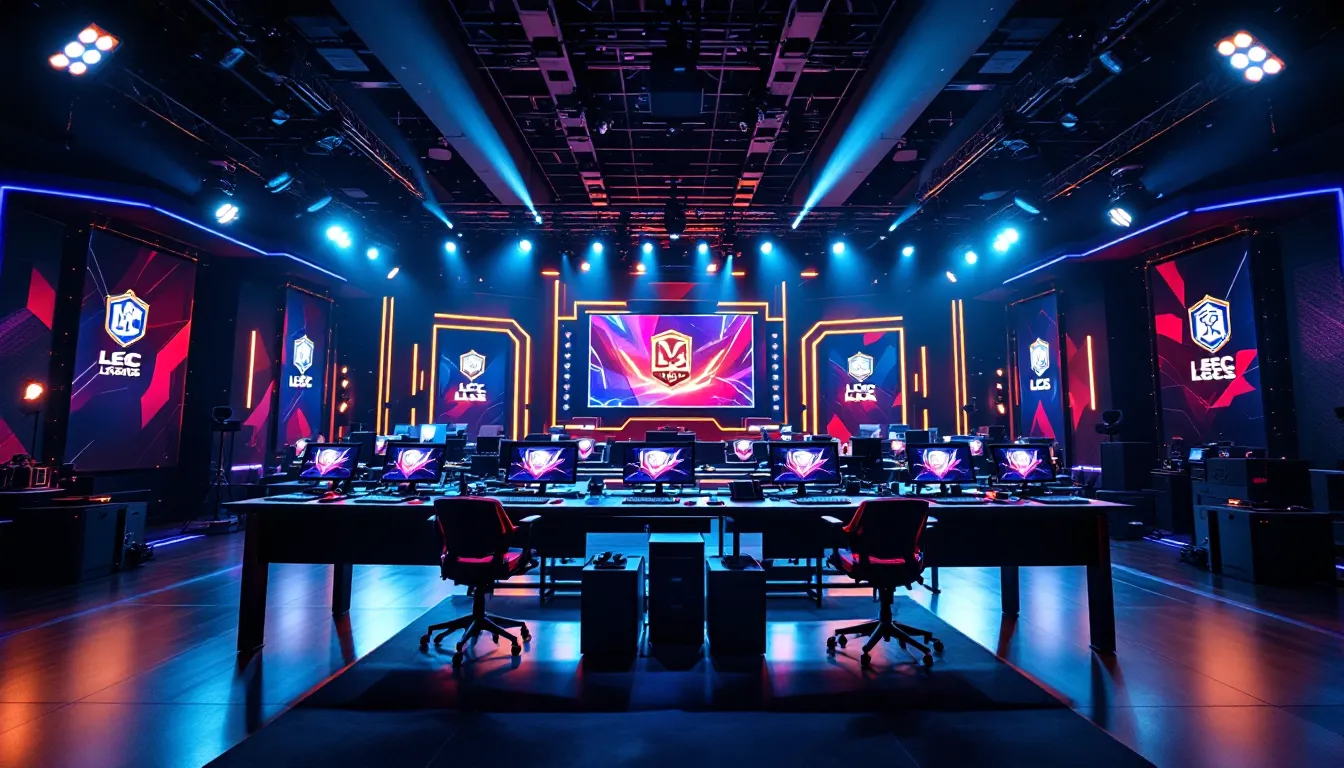
Matches are broadcast in English and regional languages, with teams like Fnatic, G2 Esports, and MAD Lions pulling massive viewership numbers. The LEC maintains one of the highest production standards in esports, premium studio sets, professional commentary teams, and consistent weekly schedules that rival traditional sports broadcasting.
Notable Teams and Players
Europe’s competitive landscape is anchored by storied franchises with deep championship histories. G2 Esports consistently fields world-class rosters and has claimed multiple regional titles. Fnatic remains a legacy organization with a dedicated fanbase and strong academy pipeline. MAD Lions has emerged as a consistent playoff contender with mechanically skilled players who often outperform expectations internationally.
The talent pool is deeper than many outsiders realize. Players like Caps (mid lane), Jankos (jungle), and emerging rookies from academy teams bring a mix of veteran experience and fresh mechanics. The LEC excels at developing well-rounded players who understand macro fundamentals, wave management, vision control, and objective prioritization, even if they don’t always match the raw mechanical prowess of other regions.
International Performance and Legacy
Europe has proven it can compete at Worlds, particularly in recent seasons where LEC representatives have reached semifinals and occasionally quarterfinals. The region’s peak came during the 2018-2019 era when Fnatic and G2 made deep Worlds runs. By 2026, LEC teams understand they must capitalize on international windows, as the competitive bar at Worlds has only gotten higher.
The LEC’s international legacy centers on teamfighting coordination and strategic draft flexibility. European teams often win through superior macro execution rather than individual outplays, a philosophy that shows in their measured, objective-focused gameplay. This playstyle has produced mixed results at Worlds, sometimes the slow-tempo approach wins championships, other times it loses to regions that prioritize faster execution and stylistic unpredictability.
The League Championship Series (LCS)
Regional Importance and Viewership
The LCS represents North American League of Legends, operating under the franchise model with ten teams competing for regional dominance. While the LCS once rivaled the LCK in viewership and international competitiveness, the region’s trajectory has shifted over the past decade. Viewership remains solid during playoffs and international events, but the league faces consistent criticism about its depth and competitive ceiling compared to the LEC and LCK.
Even though these challenges, the LCS maintains cultural importance in North America. Teams like Team Liquid and Cloud9 draw hardcore fanbases and sponsorship interest that keeps franchises financially viable. The league continues to broadcast on major platforms with professional production, though investment has plateaued compared to earlier years of explosive esports growth.
Key Teams and Rising Talent
Team Liquid remains the most storied franchise in North American League of Legends history, with multiple championship wins and consistent international qualification. Cloud9 similarly brings strong infrastructure and competitive history. These legacy organizations often sign established players with proven track records, creating stability but sometimes limiting experimental rosters.
The gap between top-tier and mid-tier LCS teams has widened significantly. While the playoff-bound teams field solid rosters, depth is a weakness. Young players coming through academy sometimes struggle with the competitive leap, and importing veteran talent from other regions has become increasingly common, a sign that the domestic talent pipeline isn’t fully meeting league standards.
Path to International Competition
LCS teams earn Worlds qualification through Circuit Points accumulated across both spring and summer splits, with additional qualification slots available through playoffs. The challenge for North American teams is consistent execution: they frequently underperform at international events, with surprising early eliminations becoming almost routine.
This pattern reflects a deeper issue: the LCS meta sometimes diverges from global trends, and teams that dominate regionally struggle against teams with more innovative or aggressive strategies. Cloud9 occasionally bucks this trend with creative picks and execution, but the region overall hasn’t produced the same international champions that Europe or Korea consistently deliver. For LCS fans, qualification to Worlds isn’t a guarantee of success, it’s usually just the beginning of regional disappointment.
The Korean League Championship (LCK)
Dominance and Championship Success
The LCK stands as the most dominant regional league in League of Legends history. Korean teams have won multiple World Championships, and the league consistently produces the game’s most mechanically skilled and strategically innovative players. The LCK’s success isn’t luck, it’s built on a culture of ruthless competition, systematic training, and an uncompromising standard of excellence.
As of 2026, the LCK operates with ten franchises competing in a split system similar to other regions. But, the competitive intensity differs dramatically. Every team in the LCK is capable of upsets, and playoff brackets feature nail-biting matches between squads that would dominate most other regions. This internal competition creates a rising tide that lifts all boats, players who thrive in the LCK almost always perform well internationally.
Legendary Teams and Playing Style
T1 represents the gold standard of LCK franchises. The organization’s history of World Championships, legendary players like Faker, and consistent excellence across multiple eras makes them iconic not just regionally but globally. Damwon Kia emerged as a power in recent years with crisp mechanical play and excellent coordination. Gen.G similarly maintains strong rosters with competitive playoff performances.
Korean teams play a distinctly aggressive, execution-focused style. They excel at early game rotations, jungle ganking patterns, and converting small advantages into snowballing victories. The macro play is technically sound, but what separates Korea is the mechanical precision: players consistently win skill matchups, land skill shots under pressure, and make fewer mechanical errors than counterparts in other regions. It’s not flashy, it’s just clean, efficient gameplay that suffocates opponents.
Teamfighting in the LCK differs noticeably from other regions. Korean teams rarely engage chaotically: instead, they position deliberately, control engage ranges, and execute predetermined patterns. This discipline comes from years of grinding solo queue in a hypercompetitive environment where mistakes get punished immediately.
Training Culture and Competitive Excellence
The Korean esports infrastructure is unmatched. Org-funded gaming houses, professional coaching staffs, sports science integration, and systematic scouting pipelines create an ecosystem where talent naturally rises. LCK players often practice 10-12 hours daily, with structured bootcamp periods before major tournaments.
This training intensity produces specialists. Mid laners in Korea are expected to play a broader champion pool with higher mechanical precision. Junglers execute complex pathing and gank timings that feel automatic. Support players make macro calls and vision plays that seem prescient. The regionalization of skill roles creates a level of consistency that makes LCK teams predictable in strategy but nearly impossible to outplay mechanically.
Solo queue culture amplifies this advantage. Korea maintains the most competitive solo queue environment globally, high elo players face professionals regularly, creating a constant proving ground for rising talent. A player grinding solo queue in Korea develops skills faster than counterparts in other regions simply because the competition is relentlessly strong.
How These Leagues Connect: Worlds and International Events
The League of Legends World Championship
Worlds is the culmination of each regional league’s season, the tournament where LEC, LCS, and LCK champions collide alongside teams from other regions. Held annually in autumn, Worlds features a group stage followed by elimination brackets where the best teams prove themselves on the world’s biggest stage. For players, Worlds is the ultimate achievement: it’s where legacies are made and careers are defined.
The qualification path differs slightly by region. The LCK typically sends the most teams due to its competitive depth and Riot’s seeding system, which rewards consistent international performance. The LEC usually qualifies 3-4 teams depending on the year, while the LCS typically qualifies 2-3. These slots are earned through Championship Points accumulated during the year, with bonus qualification through finals performances.
Worlds format changes occasionally to maintain competitive balance, but the core principle remains: prove you belong among the world’s best or go home. The tournament generates massive viewership, millions tune in for semifinals and finals, making it the most prestigious League of Legends competition globally. For the LCK, Worlds qualification is almost guaranteed for top teams: for the LCS, it’s a tougher fight: and for the LEC, it’s a consistent but competitive race.
Mid-Season Invitational and Other Tournaments
MSI occurs mid-year and serves as the international event between regional seasons. Each region sends one team (usually the spring split champion), creating a smaller but intensely competitive tournament. MSI is valuable because it shows how regions stack up before Worlds preparation begins, and it rewards consistency across the year, a team can’t just peak at Worlds: they need sustained excellence.
Azerbaijan servers, regional tournaments, and occasional all-stars events provide additional international competition, though Worlds and MSI are the prestige tournaments that matter for competitive ranking. Some years feature other tournaments like Mid-Season Cup or international friendlies, but these don’t carry the same weight as the two main events.
Comparing the Leagues: Playstyle, Meta, and Regional Strengths
Mechanical Skill and Macro Play Differences
The LCK prioritizes mechanical perfection and precise execution. Players here are expected to consistently win lane matchups, position flawlessly in teamfights, and make minimal errors. Watch an LCK match and you’ll notice clean cs, reduced deaths, and efficient rotations. This precision comes at the cost of sometimes playing predictably, opponents can prepare specifically for LCK strategies because they’re executed so cleanly that patterns become recognizable.
The LEC balances mechanical skill with adaptability and creative drafting. European teams often win through superior macro understanding, they control objectives, manage waves intelligently, and make reads on opponent positioning. They’re comfortable playing unconventional team compositions or adapting mid-series if initial strategies fail. The downside: raw mechanical play sometimes lags behind the LCK, and individual outplays are less frequent.
The LCS historically occupied a middle ground but has drifted toward inconsistency. Mechanical skills vary widely across the roster, some players are world-class, others struggle against international competition. Macro play is often weaker than the LEC, and strategic flexibility rarely matches either of the other top two regions. North American teams excel when they can leverage individual mechanical talent, but against teams that match them mechanically while executing superior macro, the LCS typically falls short.
Meta Development and Adaptation
Meta (the optimal strategy at any given time) evolves constantly, and regions influence this evolution differently. The LCK typically pioneers aggressive early game metas that emphasize individual skill and precise execution. When Korean teams dominate, junglers become roaming playmakers, mid laners become priority gold sinks, and teamfight timings become razor-sharp.
The LEC often adapts quicker to meta shifts than the LCS, fielding diverse compositions and playstyles within a single split. This flexibility means LEC teams sometimes catch opponents unprepared by playing off-meta picks or strategically unusual approaches. During certain metas, this adaptation pays dividends: during others, the region’s lack of unified identity creates consistency issues.
The LCS tends to follow trends established by other regions rather than pioneering them. Teams import successful strategies from the LCK or LEC but struggle to innovate independently. This reactive approach means North American teams are often playing 2-3 weeks of meta behind the leaders, fighting uphill battles against opponents with deeper strategic preparation.
How to Watch and Follow These Leagues
Streaming Platforms and Schedule Information
The LEC streams on lolesports.com and regional platforms like YouTube, with matches typically airing mid-week and weekends. The LCS similarly broadcasts on lolesports with consistent scheduling. The LCK maintains its own broadcast infrastructure alongside lolesports, with matches airing during Korean primetime (which falls into early morning or late evening depending on your timezone).
For competitive depth and up-to-date meta information, Mobalytics provides tier lists, patch breakdowns, and competitive build recommendations that reflect what pro players are actually using. This resource is invaluable if you want to understand not just which teams are winning, but why they’re winning and what strategies they’re leveraging.
Dot Esports offers comprehensive coverage of competitive tournaments, standings, and player news across all three regions. If you want breaking news about transfers, roster changes, or surprising upset victories, Dot Esports delivers timely reporting.
Schedules vary by region and season, so checking lolesports directly before each split ensures you don’t miss important matches. Most regions air games during evening hours in their respective timezones, with international events scheduled for times that maximize global viewership.
Getting Started as a New Fan
Start by watching playoff matches from your preferred region, these games showcase the highest level of competition and feature the most entertaining League of Legends you’ll encounter. Playoffs eliminate inconsistent teams and feature dramatic stakes, making them perfect entry points for new viewers.
Pick a team that resonates with you, whether through playstyle, player personalities, or organizational history. Following a specific team makes matches more engaging and gives you context for roster moves and competitive narratives. Don’t feel obligated to choose between regions, many fans follow top teams across all three, enjoying different playstyles and competitive stories.
Learn basic terminology gradually. Terms like “gank,” “macro,” “meta,” and “teamfight” become intuitive after watching a few matches. Don’t try to understand everything immediately: esports commentary is designed for growing complexity, and you’ll naturally pick up context clues.
Follow players on social media and watch post-match interviews. League of Legends esports has entertaining personalities, players who stream, create content, and engage with fans. Building connections to individual players deepens investment in the competitive scene and makes victories more meaningful.
Finally, engage with communities on Reddit, Discord, or fan forums. League esports fans are passionate and welcoming to newcomers who ask genuine questions. These communities discuss strategies, predict outcomes, and celebrate emotional moments, joining these conversations enriches the viewing experience.
Conclusion
The LEC, LCS, and LCK represent three distinct approaches to League of Legends competition, each reflecting the culture and competitive infrastructure of its region. The LCK’s mechanical precision and systematic excellence make it the global standard: the LEC’s adaptability and macro understanding create compelling regional competition: and the LCS remains a developing region still searching for its international identity.
Choosing which region to follow depends on what excites you. If you love flawless execution and technical mastery, the LCK rewards careful observation. If you prefer strategic diversity and unpredictability, the LEC delivers compelling matches. If you’re North American and want to cheer your region even though competitive challenges, the LCS offers local connection and occasional international surprises.
The 2026 competitive season promises continued evolution. Teams will develop new strategies, rookies will emerge, and meta shifts will reshape regional hierarchies. Whether you follow one region or immerse yourself in all three, League of Legends esports offers world-class competition, compelling storylines, and players executing the game at levels most solo queue climbers will never touch. Jump in, the competitive scene is welcoming, and the gameplay is genuinely spectacular.